
The Importance of Water for Your Garden in Tooele Valley, Utah
In Tooele Valley, water is not just part of gardening—it is one of the main things that determines whether a garden struggles or thrives. Our area sits in a dry, high-desert climate where summer heat, low humidity, wind, alkaline soils, and limited rainfall all work together to pull moisture out of the ground faster than many new gardeners realize. Tooele averages relatively low precipitation overall, with the driest stretch centered in summer, when gardens need water the most.
That is why watering well matters more here than simply watering often. In Tooele Valley, the goal is not to keep the soil constantly wet. The goal is to water deeply, efficiently, and consistently enough that roots grow down, plants stay healthy, and water is not wasted to evaporation, runoff, or poor timing. Utah State University Extension emphasizes efficient irrigation and notes that plant water use is driven by evapotranspiration, which increases with heat, sun, wind, and dry air—all things we know Tooele Valley does not exactly lack.
Why Water Matters So Much in Tooele Valley
Gardeners who move here from wetter climates often get blindsided. A bed that might stay moist for days somewhere else can dry out surprisingly fast here. Tooele’s summer pattern is especially important: rainfall drops off hard in early summer, and July is among the driest times of the year. That means your vegetables, flowers, shrubs, and young trees are usually depending on you, not the sky.
Our local soils also play a big role. Many Tooele Valley gardens have soils with clay, silt, gravel, or a mix of compacted fill and native ground. Utah State University Extension notes that soil type changes how quickly water soaks in, with sandy soils absorbing water faster and clay soils much more slowly. That matters because if you apply water too fast on tighter soils, it runs off before it gets where the roots need it.
Water is also critical because it affects more than survival. Proper watering improves root growth, nutrient uptake, flowering, fruit production, plant vigor, and heat tolerance. Poor watering, on the other hand, can lead to blossom drop, bitter vegetables, shallow roots, fungal problems, stress damage, and plants that look tired even when they are technically alive. That is not a garden. That is a hostage situation.
Deep Watering Beats Shallow Watering
One of the biggest mistakes gardeners make in Tooele Valley is giving plants a little bit of water too often. That trains roots to stay near the surface, where the soil dries out the fastest. In a hot, windy, high-desert environment, shallow roots are a bad long-term strategy.
Utah State University Extension recommends watering to actual rooting depth rather than lightly wetting the surface. Their irrigation guidance notes that trees and shrubs should be watered deeply enough to wet soil roughly 18 to 20 inches down, with the amount and soak time depending on soil type. Extension guidance for Utah landscapes also emphasizes less frequent, deeper watering rather than frequent shallow watering.
For most garden plants, that same principle still applies, even if the exact depth is different. Vegetables and perennials do not need the same rooting depth as trees, but they still do better when water penetrates well below the immediate surface. In Tooele Valley, deep watering helps plants become more resilient between irrigations and better able to handle heat spikes.
Why Drip Irrigation Is So Valuable Here
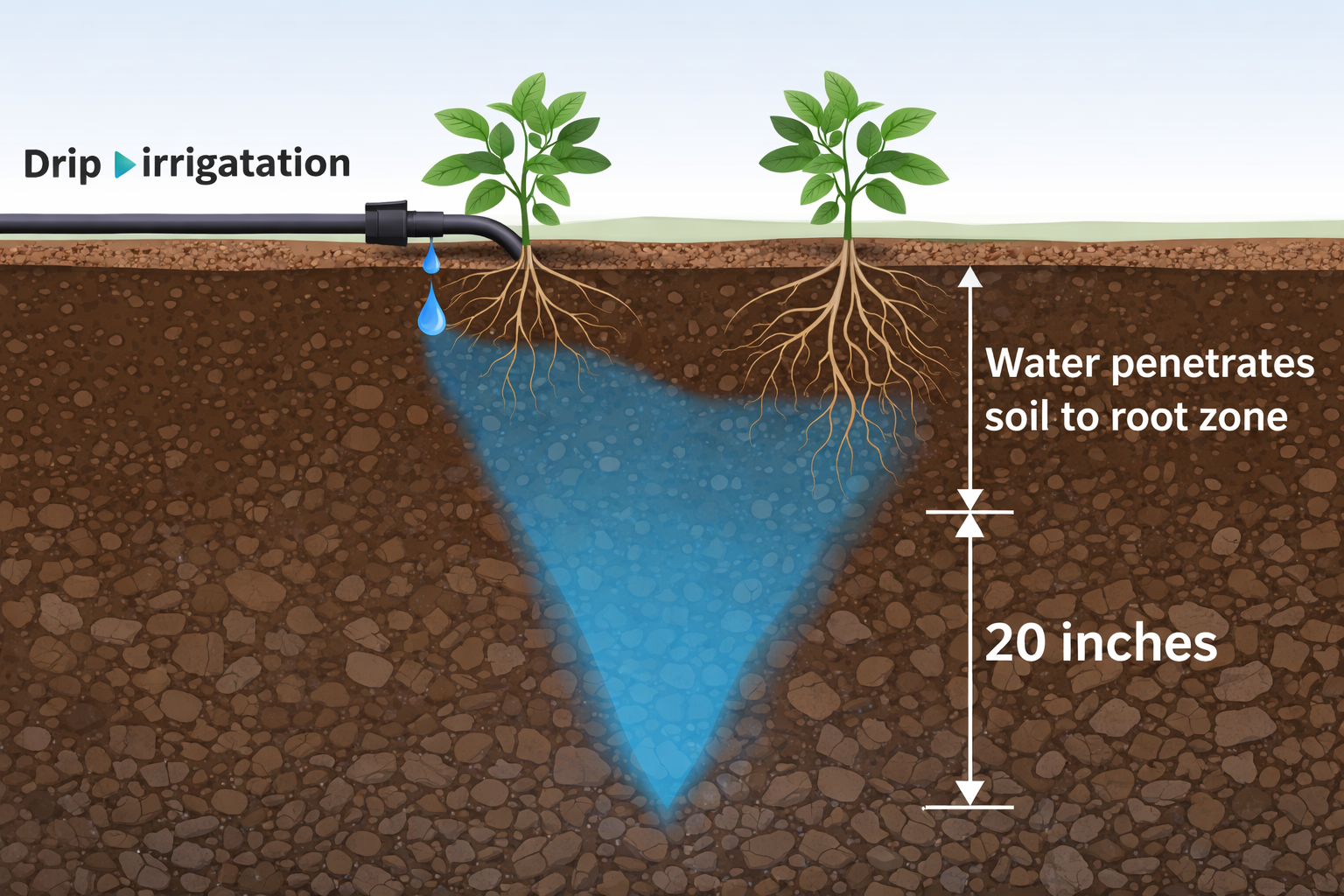
If there is one irrigation method that makes a ton of sense in Tooele Valley, it is drip irrigation. Utah State University Extension specifically highlights drip as a practical water-saving strategy for Utah landscapes, and EPA WaterSense notes that microirrigation systems can use 20 to 50 percent less water than conventional sprinklers because they apply water slowly and directly to the root zone.
That matters here for a few reasons. First, our dry air and sun can cause water sprayed through the air to evaporate before it ever reaches the ground efficiently. Second, wind can push overhead water off target. Third, many of our beds and xeriscape plantings do not need broad spray coverage anyway. Drip lets you put the water exactly where you want it and nowhere else.
Drip systems are especially useful for:
- vegetable gardens
- flower beds
- shrubs
- trees
- raised beds
- xeriscape plantings
- foundation plantings
- mixed borders
Utah State University Extension also notes that drip systems are generally more efficient than overhead irrigation, with efficient drip systems often operating in the 90% to 95% range, compared with roughly 70% to 80% for overhead irrigation.
Soaker Hoses: A Good Simpler Option
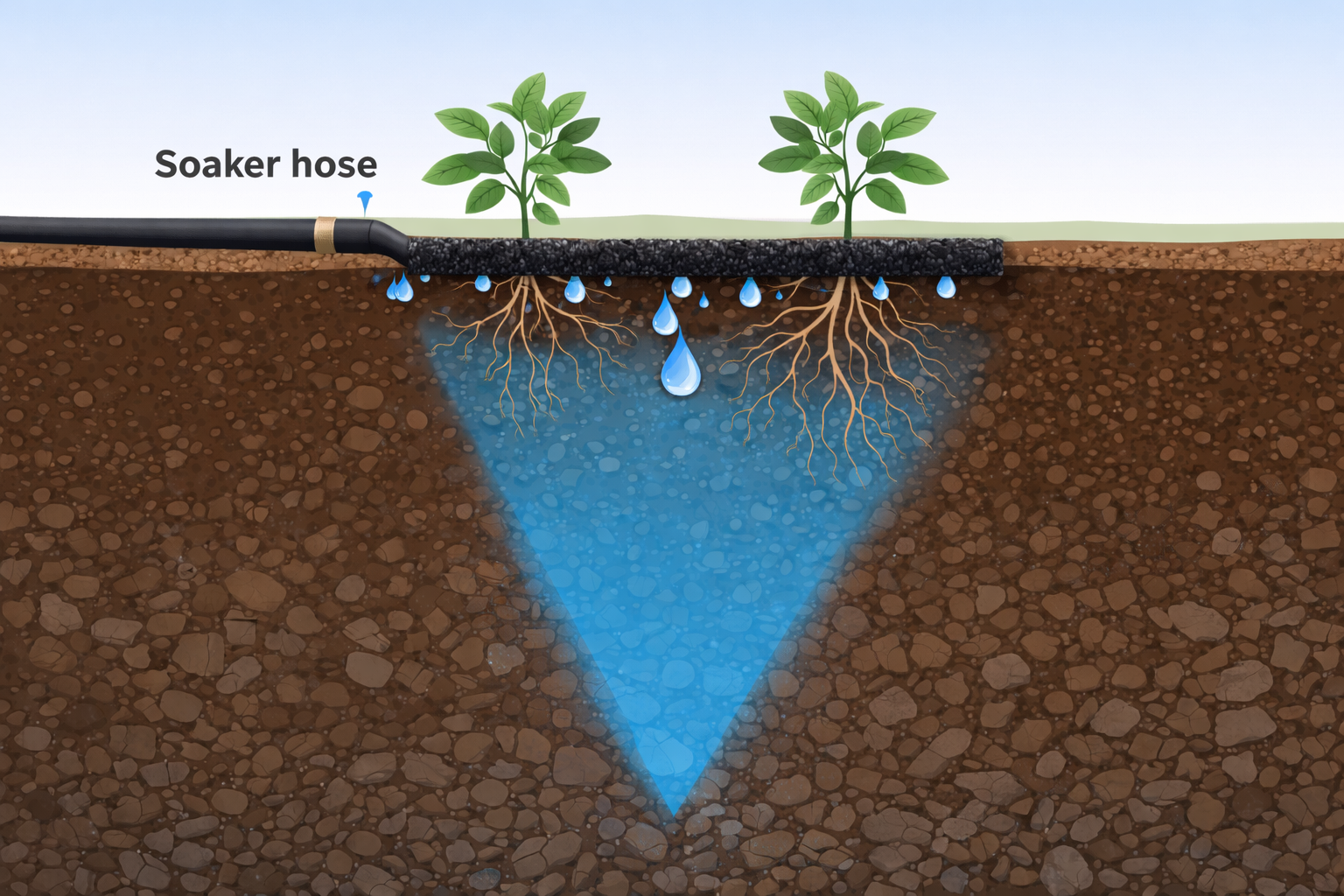
Soaker hoses can also work well in Tooele Valley, especially for home gardeners who want a simpler setup without designing a full drip system. A soaker hose releases water slowly along its length and can be useful in vegetable rows, perennial beds, and informal planting areas.
The advantage of soaker hoses is that they are simple, relatively affordable, and easy for beginners to install. The downside is that they are usually less precise than a well-designed drip system and can be less uniform over long distances or on slopes. In other words, they are good, but drip is usually the more professional and controllable option.
For many home gardens, the best answer is:
- drip for permanent beds, shrubs, trees, and structured plantings
- soaker hoses for seasonal vegetable rows or simple temporary layouts
How Often Should You Water?
This is the question everybody wants answered with one magic number, and nature rudely refuses to cooperate.
In Tooele Valley, watering frequency depends on five main things: plant type, soil type, weather, sun exposure, and irrigation method. Utah State University Extension notes that shady areas often need water less frequently than sunny ones, and sunnier areas may need irrigation every 5 to 7 days while shady areas may stretch closer to every 10 days under restricted landscape conditions.
For home gardens in Tooele Valley, a practical starting point looks like this:
Vegetables Most vegetables need consistent moisture to perform well, especially tomatoes, peppers, cucumbers, squash, beans, and lettuce. In peak summer, vegetable beds often need watering several times per week, particularly if they are in raised beds or sandy soil. With drip or soaker systems, it is usually better to water deeply and adjust by weather rather than running them lightly every day. USU and WaterSense both emphasize adjusting schedules seasonally and irrigating only when needed.
Flower Beds and Perennials Established perennial beds usually need less frequent watering than vegetables, but they still need attention during hot, windy stretches. Deep watering every few days to weekly may be enough, depending on soil and exposure. New plantings need more frequent irrigation until roots establish. EPA also recommends regionally appropriate plants and mulch to reduce irrigation demand.
Shrubs and Trees Woody plants generally do better with deeper, less frequent watering. Utah State University Extension advises watering trees and shrubs to a significant soil depth, not with quick surface sprinkles. That usually means longer run times but fewer events.
Xeriscape Plants Established xeriscape plants need far less irrigation than turf or thirsty annuals, but “xeriscape” does not mean “never water.” Even drought-tolerant plants need regular water during establishment, and many still benefit from occasional deep irrigation in long hot spells. Utah water-conservation guidance also notes that water-wise plants can do well with lower amounts of water when managed properly.
Best Time of Day to Water In Tooele Valley, the best time to water is early morning. That reduces evaporative loss, allows foliage to dry during the day if any gets wet, and gives plants moisture before afternoon heat ramps up. WaterSense guidance also stresses correct timing, proper direction of irrigation, and avoiding waste from bad programming or leaks.
Evening watering can work when necessary, especially with drip systems that do not wet foliage much, but early morning is still the cleaner choice. Midday watering is the least efficient because more of the water is lost to heat and evaporation.
How the Local Environment Changes Water Need Tooele Valley is not just dry. It is dry, bright, windy, and often exposed. Those factors stack.
A plant in full afternoon sun near concrete, rock mulch, fencing, or a south-facing wall will dry much faster than the same plant in filtered light with organic mulch around it. Raised beds also dry faster than in-ground beds. Wind increases evapotranspiration, and our low humidity speeds moisture loss from both soil and leaves. Utah State University Extension’s irrigation materials specifically tie irrigation demand to ET, which is influenced by local weather conditions.
That means a watering schedule that works in May may be badly wrong in July. It also means one part of your yard may need water more often than another. The sunny west side of a property in Tooele can behave like a completely different planet than a sheltered east-facing bed.
Mulch Is Basically Your Water’s Bodyguard If you want to make every gallon count, mulch your beds. Organic mulch helps moderate soil temperature, reduce evaporation, suppress weeds, and improve soil over time. EPA WaterSense specifically recommends mulches as part of water-smart landscaping.
In Tooele Valley, mulch is not optional if you want to garden smarter. Shredded bark, wood chips, composted mulch, or similar materials around shrubs, flowers, and vegetables can make a real difference in how often you need to irrigate. Bare soil dries out faster, crusts more easily, and invites weeds that steal your water.
Watch for These Signs You’re Watering Wrong Too little water can show up as wilting, dull leaves, blossom drop, leaf scorch, stunted growth, and dry soil below the surface. Too much water can show up as yellowing leaves, mushy roots, fungus issues, and plants that look strangely weak despite “getting watered all the time.”
Because Tooele soils vary so much, the smartest habit is to check the soil itself. Do not just look at the surface. Dig down a few inches in vegetable beds or use a probe or screwdriver in deeper beds and shrub zones. If the surface is dry but the root zone is still moist, you may not need to water yet. If only the top inch is wet after irrigation, your system likely needs adjustment.
Simple Watering Advice for Tooele Valley Gardeners A good starting approach for local gardeners is this:
Water deeply, not constantly. Use drip or soaker systems whenever possible. Adjust frequency upward in peak summer and downward in spring and fall. Water earlier in the day. Mulch generously. Group plants with similar water needs together. Check the soil before automatically adding more water. And remember that new plants always need more attention than established ones.
Utah homeowners can also use USU’s landscape irrigation tools and Water Check resources to fine-tune schedules and improve efficiency. USU’s irrigation calculator notes that drip systems are highly efficient, and the Water Check program exists specifically to help Utah residents improve irrigation performance.
Final Thoughts
In Tooele Valley, smart watering is one of the biggest differences between an average garden and a truly successful one. Our high-desert climate does not leave much room for sloppy irrigation habits. But the upside is this: when you water with intention—deeply, efficiently, and according to the season—your plants get stronger, your soil performs better, and your garden becomes far more resilient.
Water is life in any garden. In Tooele Valley, it is also strategy.
If you want, I can also turn this into a more polished WordPress post with a title tag, meta description, subhead SEO structure, and a short call-to-action for joining TVGA.